What Does OpenAI's LifeVal Actually Test? We Read the Paper
On November 3, OpenAI released a new benchmark, LifeVal: 169 everyday tasks. An AI uses a browser, a computer, and connectors to get things done for you — transferring a child into a new school and finding a kindergarten, planning meals for a parent just diagnosed with diabetes, handling government paperwork, managing a household budget.
We work on agent computer use, so I wanted to see what this actually is.
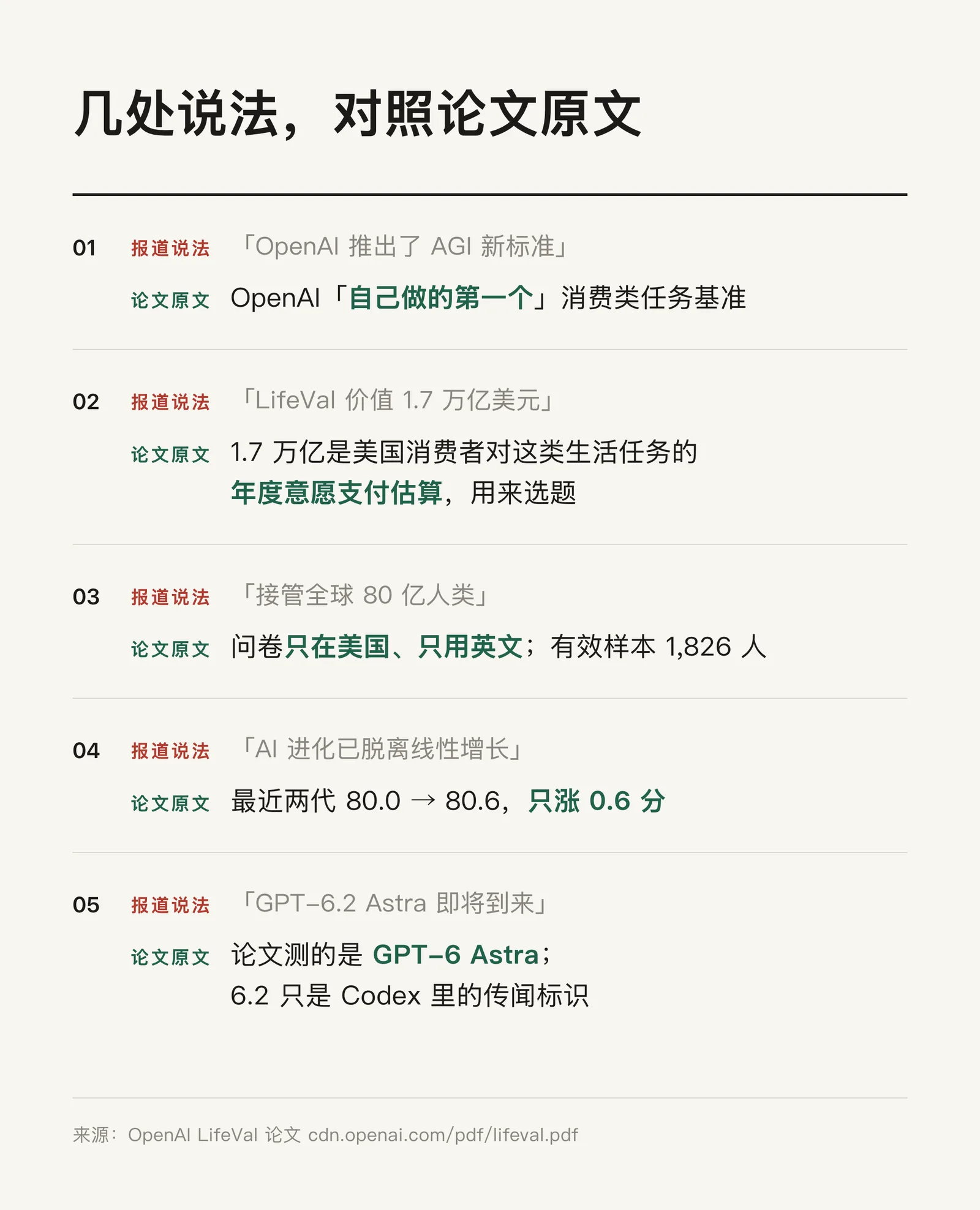
The XinZhiYuan headline was loud: "Today, OpenAI released a new standard for AGI! Worth $1.7 trillion, taking over 8 billion humans."

We read OpenAI's 16-page paper all the way through.
It is impressive. How impressive, though, you cannot say without a comparison.
So the rest of this piece first explains what it tests, how it scores, and what it found, and only then sets it next to other established benchmarks.
1. What LifeVal tests
The paper is titled "Evaluating AI Model Performance on Personalized Agentic Consumer Tasks." It has 169 tasks across 7 domains: care, health, education, household administration, personal finance, shopping, and government services.
Unlike question-answering benchmarks, LifeVal asks the model to act as an agent: browse the web, operate a computer, and call connectors such as email and calendar inside a simulated environment, then hand back a result someone can actually use. A single task can run for up to 8 hours.
Examples OpenAI showed
Enrolling a child in a suitable kindergarten after a move
Organizing volunteers before a flood
Preparing a week of meals for a parent just diagnosed with diabetes
Watching a ball game remotely with a grandmother
The tasks are also "personalized." Task authors build the background from their own de-identified ChatGPT history and memories. The model has to understand who you are and what you want from that information before it can do the work.
2. Where the tasks come from
OpenAI did not have researchers invent a list. They started from time-use surveys: the American Time Use Survey (ATUS) and the Multinational Time Use Study (MTUS), which covers 25 countries, and listed the 148 kinds of things people spend their days on.
They then ran a survey: if you had a perfect digital assistant, how much would you pay for it to handle each kind of task? 3,837 people answered. After attention checks, 1,826 remained. The sample was recruited to match the U.S. population.
Converted from that willingness to pay, these life tasks correspond to about $1.7 trillion a year in the United States. How many questions each category gets follows that proportion.
Each task author had to have done the thing personally, more than once, and watched the result play out in real life for more than a year. Every task went through at least three rounds of human review.
3. How it is scored
Each task has its own rubric. Scores run from 0 to 1, and the total is the average of the 169 tasks. The grader is GPT-5.6 (xhigh reasoning). It looks at the model's final reply, the files it produced, and changes in the environment's backend state. Saying "I booked it" when the backend has no booking does not score.
A separate "cheat detector" scores zero if the model calls internal environment APIs and skips the normal steps.
To check whether the model grader is trustworthy, 17 human reviewers each scored 30 tasks: humans averaged 83.6, the model 84.2, with a correlation of 0.864.
4. What it found
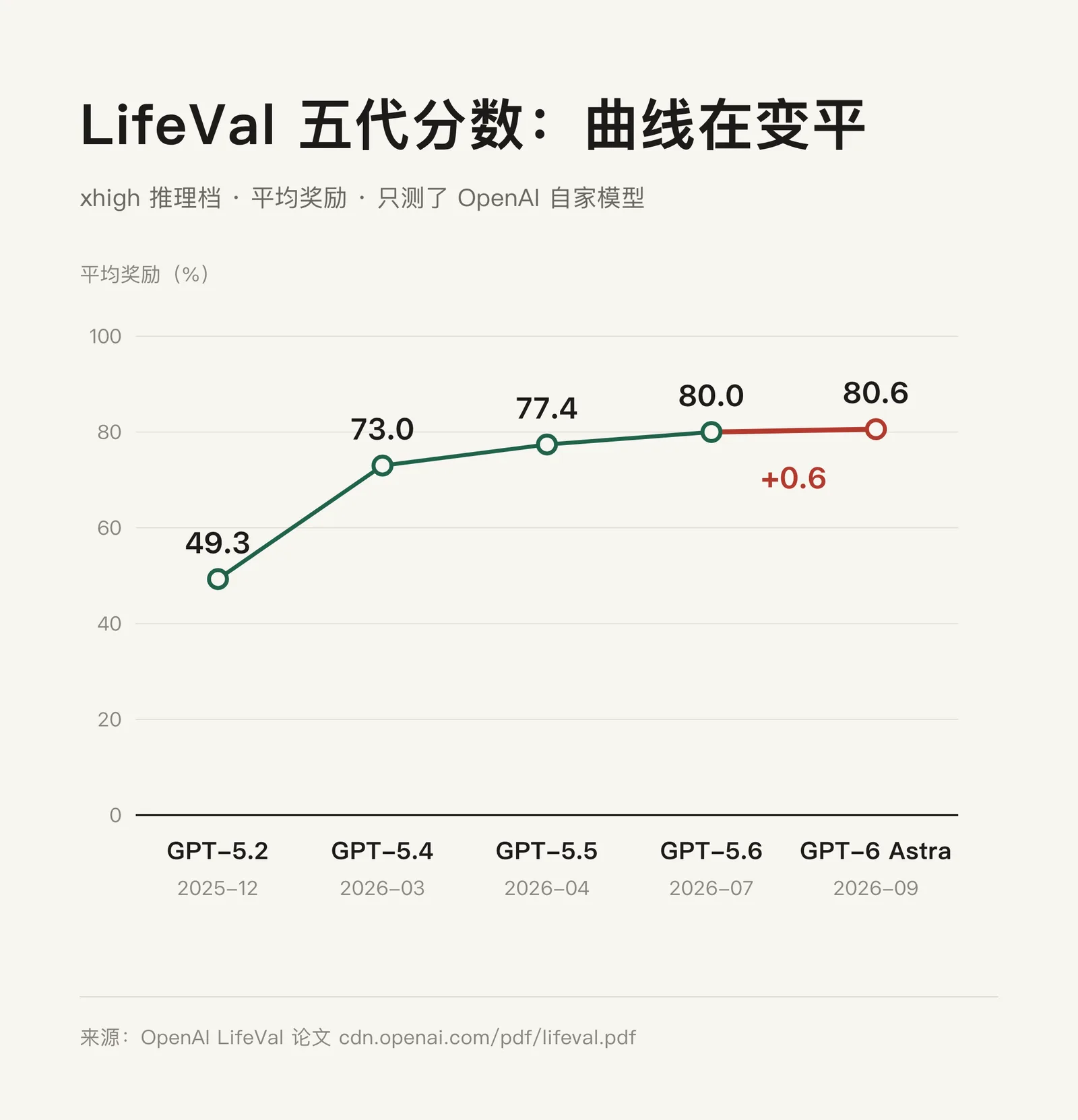
LifeVal has so far tested only five generations of OpenAI's own models (xhigh reasoning): GPT-5.2 at 49.3%, GPT-5.4 at 73.0%, GPT-5.5 at 77.4%, GPT-5.6 at 80.0%, and GPT-6 Astra at 80.6%.
In a year it went from under half to about eighty percent. Most of the gain was in the first two generations. The latest two differ by 0.6 points.
Reasoning effort matters a lot. GPT-6 Astra scores 66.6% at low, 77.6% at medium, 80.7% at high, and 82.5% at max. Past high, more compute buys very little.
The paper also splits the results in an interesting way: the model uses background given directly in the task best, and uses information buried in past chats worst (pass rates on the related rubric items: 55.8% versus 33.3%).
"Remembering you" still has a long way to go.
The most common failure is giving wrong information or advice.
5. Its limits
The paper lists three limits of its own: the time-use data stops around 2021; the willingness-to-pay survey was U.S.-only and English-only; the web is an offline cache, so time-sensitive tasks can come out differently on each run.
A few other things worth knowing
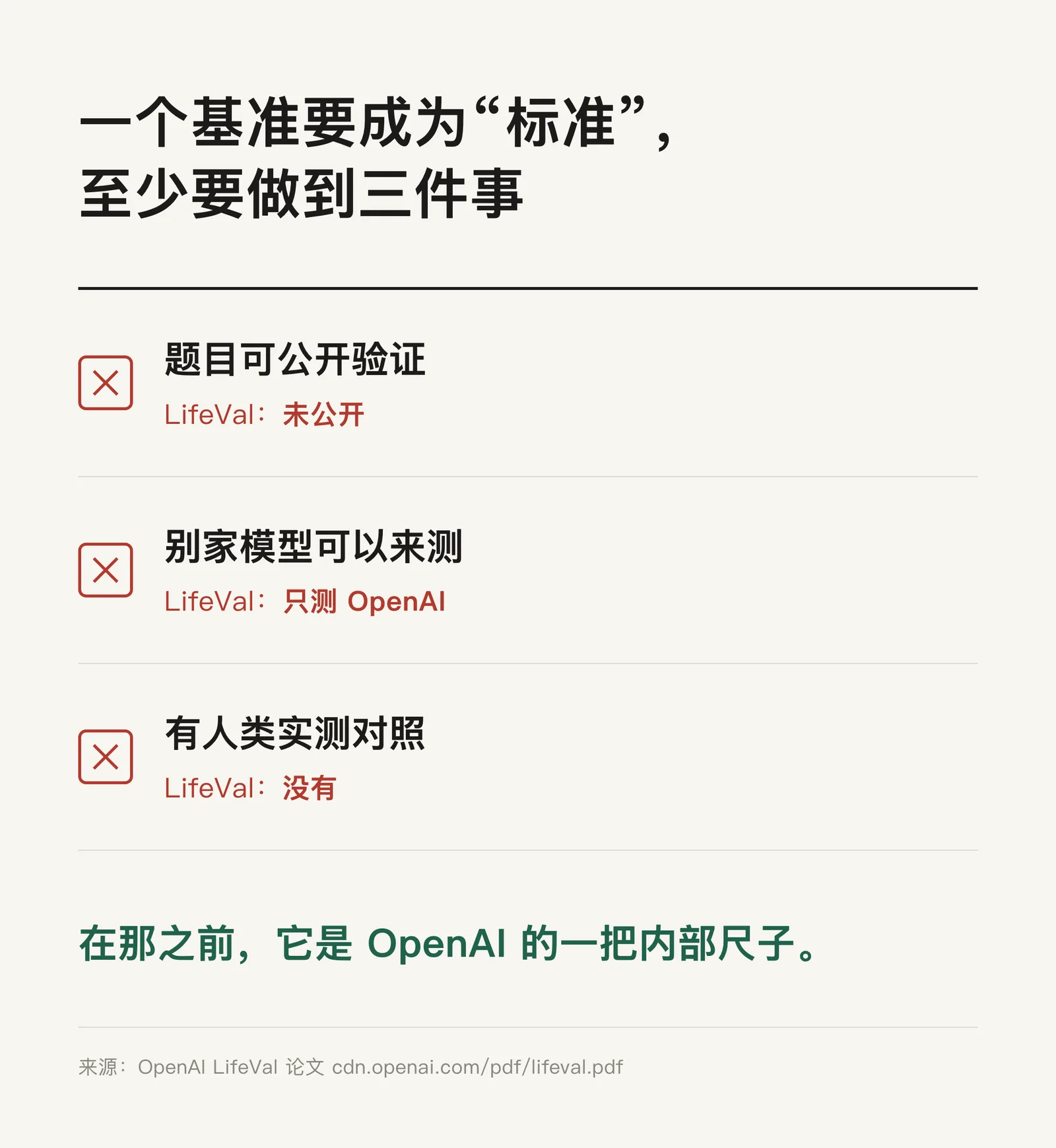
So far it has tested only OpenAI's own models. No Claude, Gemini, or open models.
The tasks, rubrics, and grader are not public, so outsiders cannot reproduce the result yet.
There is also no score for a human doing the same tasks as a comparison.
6. Next to other established benchmarks
We put the better-known agent and real-work benchmarks in one table. Most are maintained by independent groups, with public tasks that anyone can run.
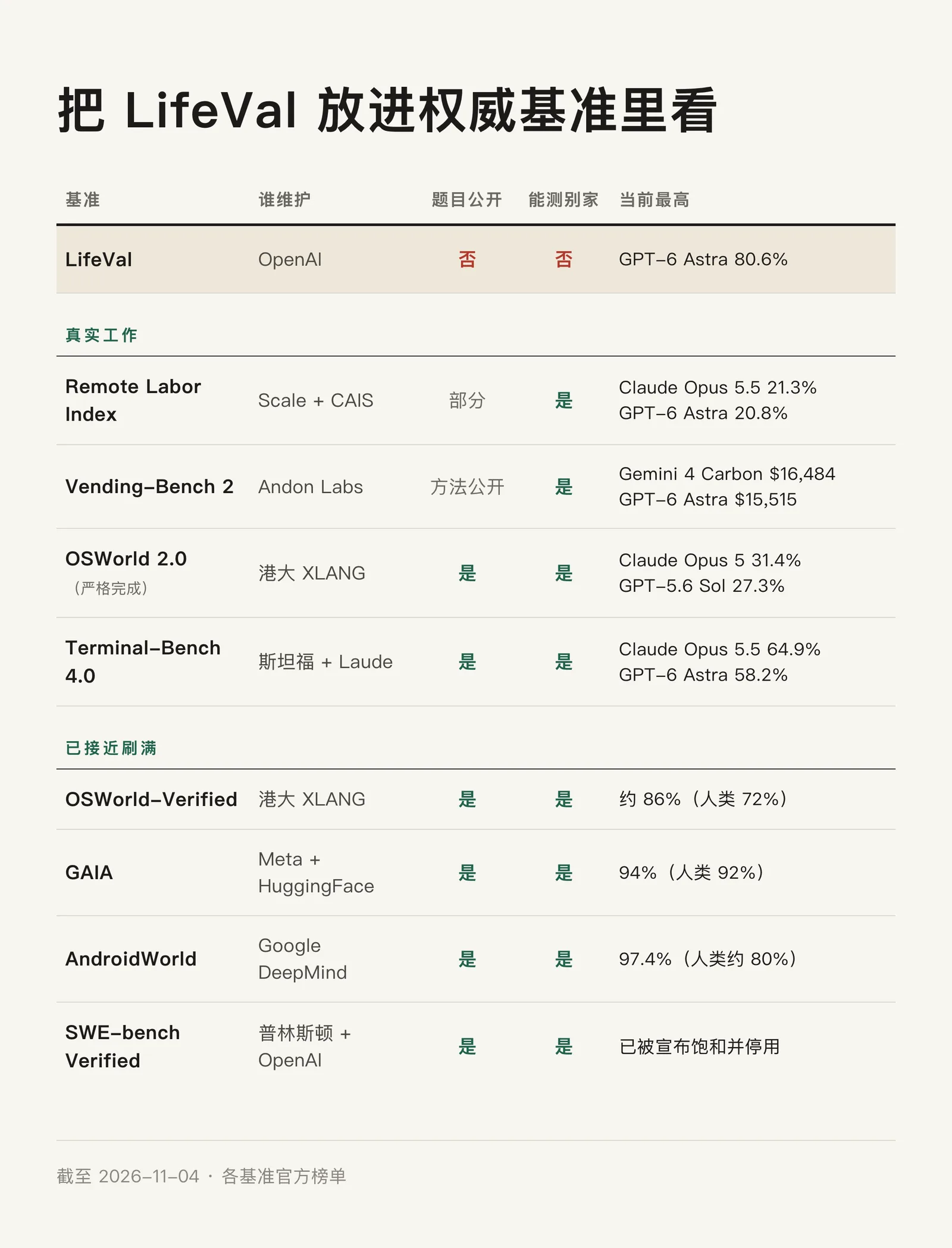
The closer an independent benchmark gets to real work, the lower the scores.
Remote Labor Index accepts 240 real freelance projects. The best score is only 21% (Claude Opus 5.5 at 21.25%, GPT-6 Astra at 20.83%). On OSWorld 2.0, long computer-use workflows, the strict completion rate tops out around thirty percent. On Vending-Bench 2, where an AI runs a vending machine for a year, Gemini 4 Carbon is first and GPT-6 Astra is second.
A set of older benchmarks is close to saturated: the top scores on OSWorld-Verified, GAIA, and AndroidWorld are all above the human baseline, and OpenAI has retired SWE-bench Verified as saturated.
So LifeVal's 80.6% cannot be lined up against those numbers. The environment, the scoring, and the models entered are all different. It is closer to an internal ruler OpenAI uses to track its own models.
7. Back to that headline
The XinZhiYuan piece got a lot of the paper's details right, and overreached in a few places. LifeVal is the first consumer benchmark OpenAI built itself. It is not a "new standard for AGI." The $1.7 trillion is a willingness-to-pay estimate used to choose tasks, not value this benchmark or AI has already created. "GPT-6.2 Astra" is still only a rumor.
"AI that handles the errands of daily life" is a direction worth paying attention to, and the way LifeVal chooses tasks is worth borrowing for teams that build agents.
It can become a ruler the industry shares only once the tasks are public, other models can be tested, and there is a human comparison.
Sources: the OpenAI LifeVal paper, cdn.openai.com/pdf/lifeval.pdf; the official leaderboards for Remote Labor Index, Vending-Bench 2, OSWorld, Terminal-Bench, GAIA, and AndroidWorld, as of November 4, 2026.