DeepSeek's New Design: Reading the Super-Agent Harness
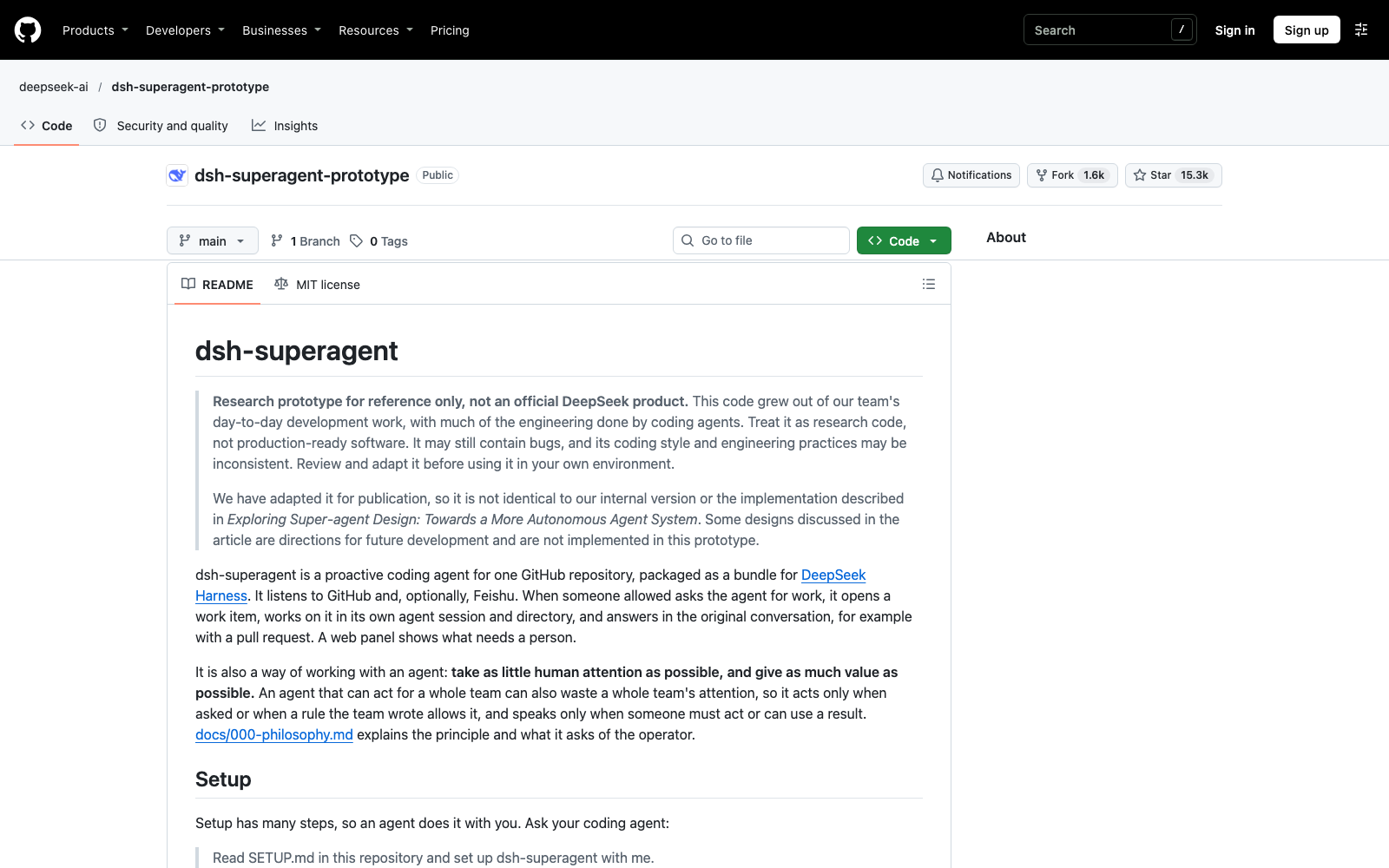
On the evening of October 31, the DeepSeek Harness team published a design article called "Exploring Super-agent Design," and open-sourced a research prototype at the same time.
It is not a new model, and it is not a new product. It is a set of architectural ideas for an Agent system. The core judgment is only one sentence: the bottleneck is no longer in the model; it is in the person.
What I felt after reading it is that the layer they want to build, we have already made into a product on Nexting and are using. This piece lines the two sides up item by item, and writes clearly both what has been done and what has not.
What Super-agent has to solve is this: one person cannot keep watch over that many Agents. What Nexting does is the layer between a person and multiple Agents, and multiple computers.
What DeepSeek Is Saying
First, two words. An Agent is an intelligent assistant that can act on its own. It can read a project, change files, and run commands. A Harness is the shell wrapped around the model, giving it hands and eyes.
In August, DeepSeek open-sourced its own shell, called DeepSeek Harness. This Super-agent is one step they are taking forward on that shell.
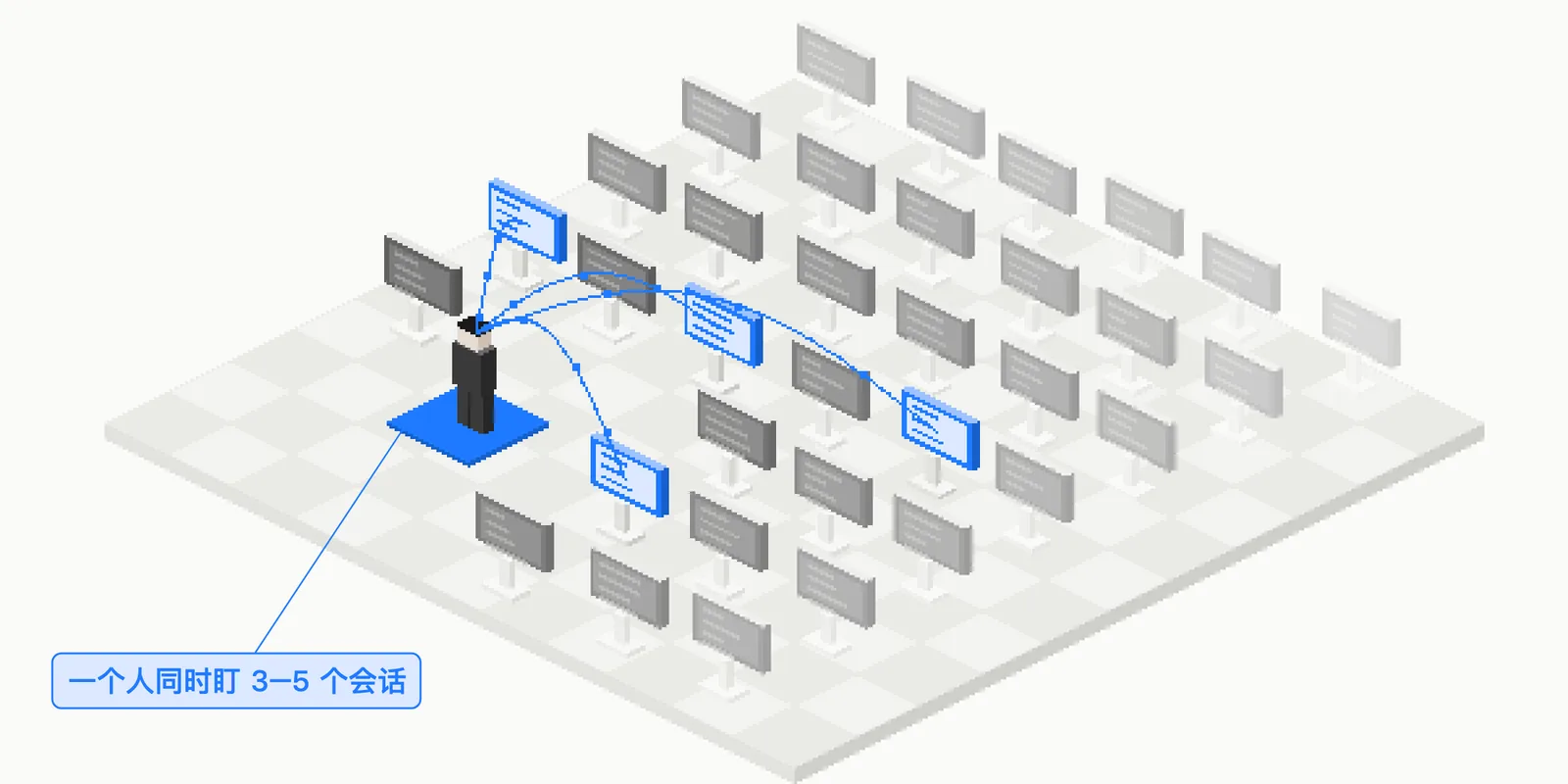
The article opens with something many people have felt: one person hits the limit watching three to five sessions at the same time. (Of course, it varies from person to person. For someone with ADHD like me, following ten-plus Agent sessions at the same time may let me get into a flow state better.) At the same time, the explosion of Personal Agent has in fact made the need to lower users' cognitive load even more urgent.
An Agent today is one session at a time. You assign it work, wait for it to do it, look at the result, then carry context back and forth among a few sessions. Models keep getting stronger, and what gets stuck is the person's attention.
You could really say attention is all you need.
So they want an Agent that is online all the time. It can push many things forward at the same time, go find work on its own according to rules the team has written, and recover by itself when something goes wrong. The person is only responsible for the final call and for acceptance.
So when I saw the news of this DeepSeek release, what I was actually thinking was: we are doing exactly this.
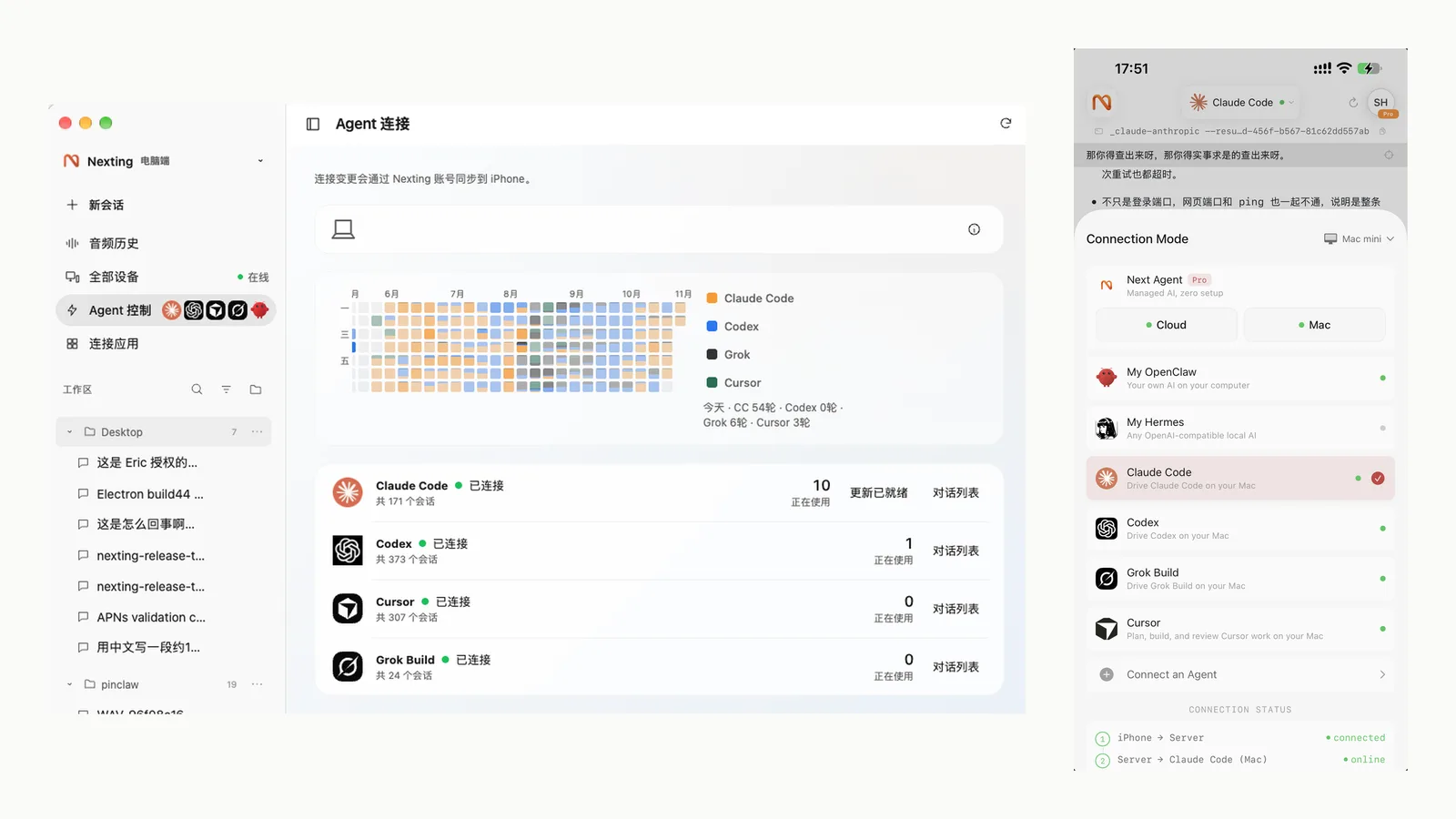
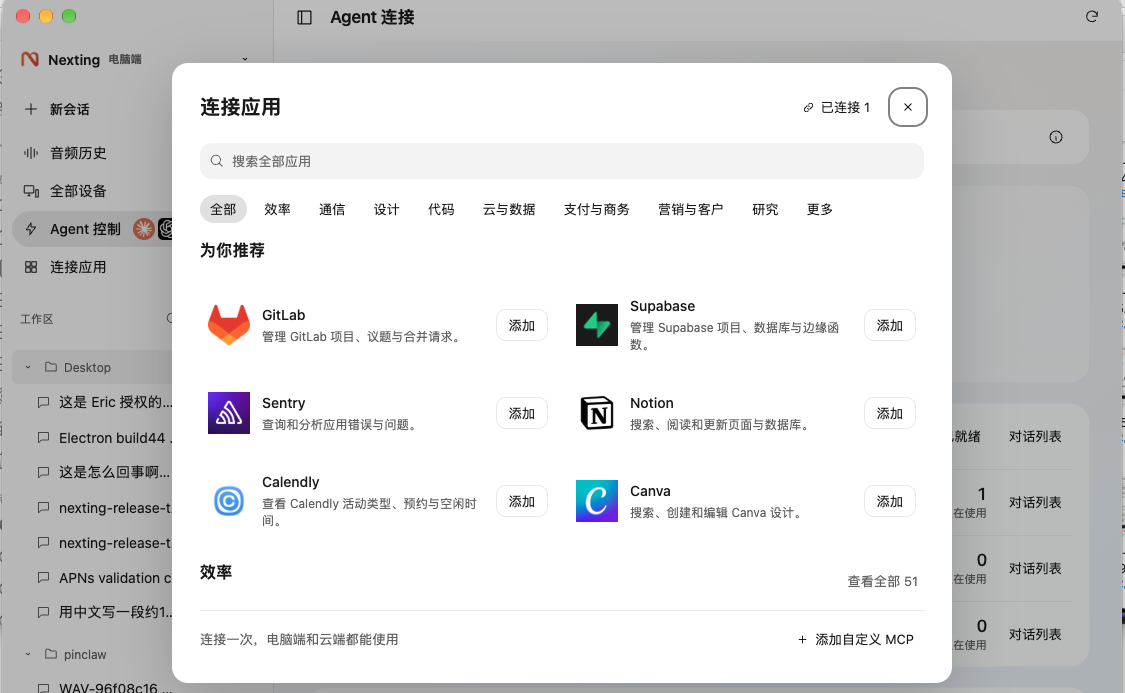
Nexting itself is a manager of Agents. Our positioning is a butler Agent. Because we have implemented stable, end-to-end control of Agents for many users. You could say our core is Agent + remote control. On the basis of having implemented remote control, we can, with the user's authorization, use our own Agent to arrange tasks for the user, publish information, and so on. So in our APP you can see the usage of all your Agents. That is to say, we do not only provide a product service like Codex; at the same time we also provide a product ecosystem that lets you use Agents across devices.
Back to Super Agent.
Its architecture is divided into five blocks.
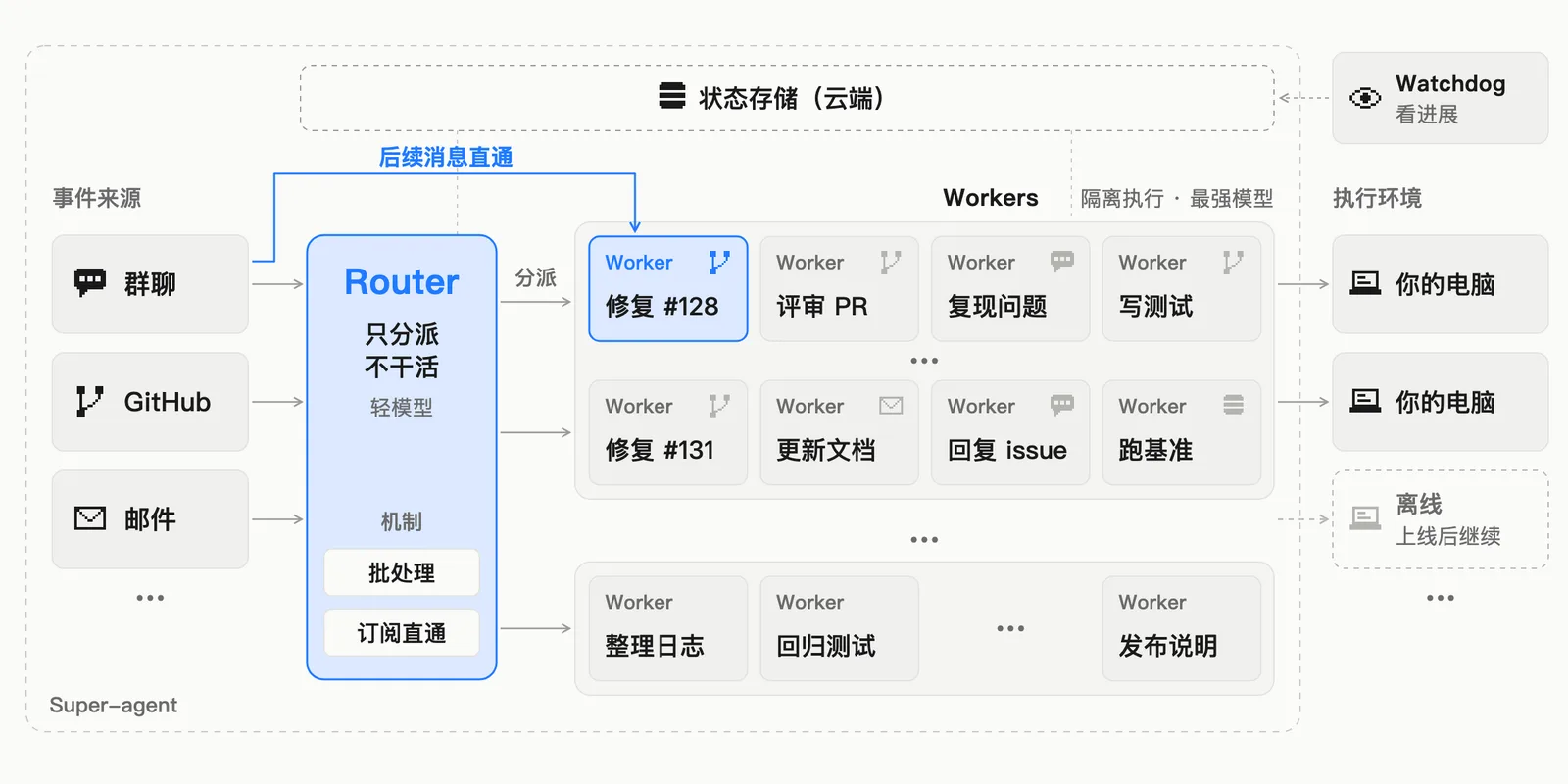
- Two layers: in the foreground, one dispatcher that only assigns and does not do the work; in the background, a bunch of execution sessions that only do the work and do not jump in
- Event-driven: watching group chats and GitHub, finding on its own what needs to be done
- Asynchronous: dispatch it and return; the foreground keeps talking as usual, the background does the work slowly
- Separation of storage and compute: the state is stored, the work is done on the user's own computer, and it can carry on even when the computer is sometimes there and sometimes not
- Watchdog: open another session, watching whether the system has hung and whether the task is making progress
In their simulation experiment, the median time for this design to finish a batch of tasks is 12.4 minutes, and a single session is 20.4 minutes. The cost is that cache-read tokens are about 3.8 times as many.
DeepSeek itself also says this very frankly. The prototype is not production-grade; some of the designs in the article have not yet been written into the open-source code; the code-writing in the experiment is simulated with a tool that consumes time, and what is measured is scheduling, not code quality.
I think this is genuinely real. DeepSeek's Harness team is itself also very pragmatic and sticks to the facts. I like it a lot.
Only a great team can make a great product.
Below, I take its architecture apart in concrete detail.
First, Look at What It Is Trying to Break
The article sums the goal up in four words: continuous, efficient, proactive, persistent.
Continuous means you raised plan A in Feishu, and later changed it to plan B in a PR comment, and it can pick up the thread. You feel there has always been only one Agent, and you do not have to think, "is this information in that session or not." Efficient means the previous thing is not finished, and the next instruction can still be taken. Proactive means it watches the events in the environment itself, pushes forward what is worth handling, and stays quiet when no intervention is needed. Persistent means it is online all the time, connected directly to your real working environment, and can recover by itself when something goes wrong.
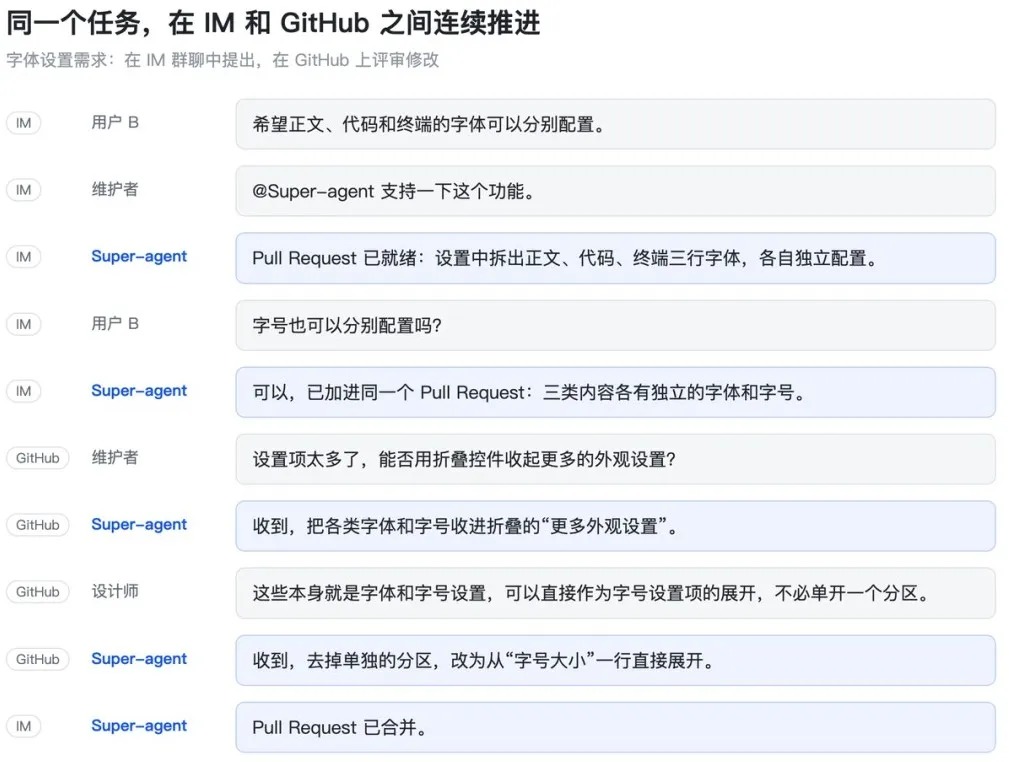
The article's judgment is that a single Agent loop cannot do these four things, and adding however many more CLIs, MCPs, and connectors is useless: it still runs inside one synchronous session, a long operation will block, context between tasks will get crossed, and the moment a device goes offline everything stops. To do it, the only way is to build a system on the outside.
There is one sentence of theirs I like a lot: A Session should be an implementation detail of the system, not a mental burden on the user. Having the user manage sessions themselves, in its view, is to a large extent a design habit inherited from the underlying large-model API.
The whole article does not put forward a new theory either. The author says so himself: it is taking classic engineering ideas from computer systems and moving them onto Agent systems. Each piece below can basically be traced to the old concept it borrows.
Two-Layer Architecture: The Router Only Assigns, the Worker Only Does the Work
The starting point is a contradiction: continuity and throughput are hard to have at the same time.
Stuff every event into the same session, and the context is the most continuous, but the model can take only one step at a time, throughput is very low, and the in-between details of several things get stirred together. The other way around, open a new session for every event, and concurrency is at its maximum, but no one can see the whole picture, the results are cut off from each other, several sessions come back to you separately, and the person is even more confused.
Its solution is to split into two layers.
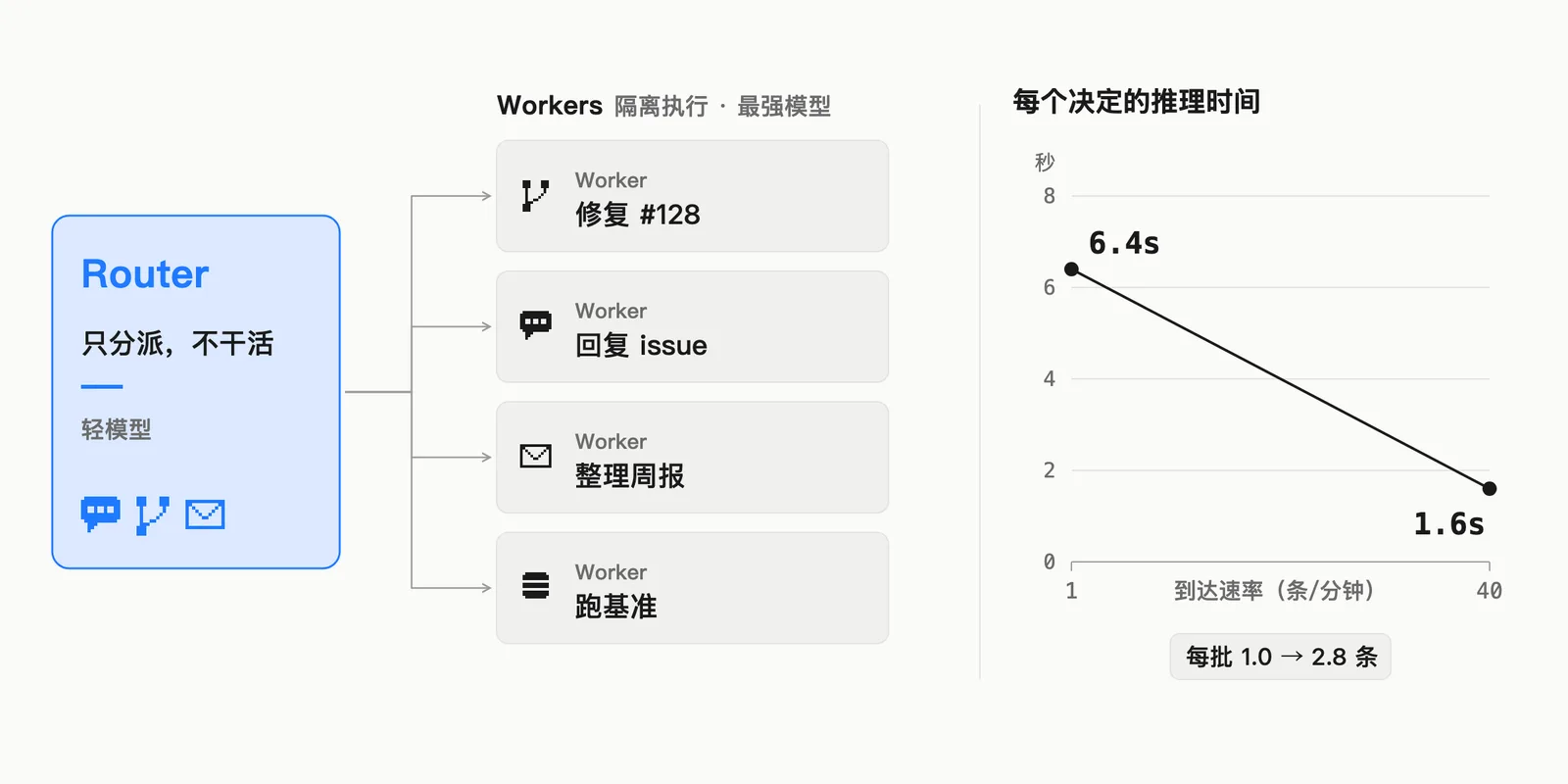
The Router layer is a resident global router. It receives the human interaction that comes in from every entry, and it is the "sequence point, coordination point, and memory" of the whole system. It deliberately does not do the concrete work. It is only responsible for talking to the person and assigning tasks. In the prototype its tool set is smaller than the Worker's, and the article even says it can be given no Bash. The reason is practical: it is the single global node, and the moment it steps in itself it becomes a bottleneck; and its work is not as complicated as one imagines, so a lighter model is often enough.
This is not the same as a common Agent Team. The lead in a Team has to understand the task in depth, split it into subtasks, and coordinate the members often, and the reasoning burden is very heavy. The Router does not split a single task. It only tracks, at a high level, the relationships between tasks.
The Worker layer is a set of execution sessions isolated from each other, mounted with the full set of execution tools, usually given the strongest model, with one Worker focused on only one thing. A Worker never faces the person directly. Its reasoning process and tool logs do not appear in the group chat. Status is reported uniformly to the Router, and the Router is the one that speaks outward. Workers generally do not communicate with each other directly either. If two Workers run into the same PR, both of them have subscribed to this discussion, what they see is the same events, and the conflict is discovered and resolved there on its own. As for a Worker starting sub-Agents inside itself, or even being an Agent Team itself, that is all transparent to the Router.
One detail shows systems thinking very well: batching. In this round of the Router's reasoning, events that have just arrived queue first, and in the next round they are merged and handed to the model all at once. Every step of the Router is "long input, short output." The merged input is computed in parallel in the prefill stage, so the time a single request takes grows far more slowly than the batch. In the stress test, as the event arrival rate rose from 1 per minute to 40 per minute, the average per batch rose from 1.0 items to 2.8 items, a single request went from 2.5 seconds to 3.9 seconds, but the inference time spread onto each decision fell from 6.4 seconds to 1.6 seconds. The busier it is, the lower the unit cost.
Thread and Subscription: Later Discussion Finds the Person Doing the Work on Its Own
The same PR, the same group-chat topic, the same string of email back-and-forth: the events that happen before and after form a Thread. When the Router sees the first event of a Thread and decides to take the work, it creates a Worker, and has this Worker subscribe directly to this Thread.
Messages that come in later on this Thread are delivered by code straight into the Worker's hands, and do not go through the Router for another round of reasoning. This is called passthrough. It corresponds to the Fast Path in computers. The Router only goes and judges those new events that do not yet have a subscriber, which is the Slow Path. The effect is: someone raises a new comment on the PR, and there is no need to @ the bot once more. The Worker that is doing the work receives it on its own.
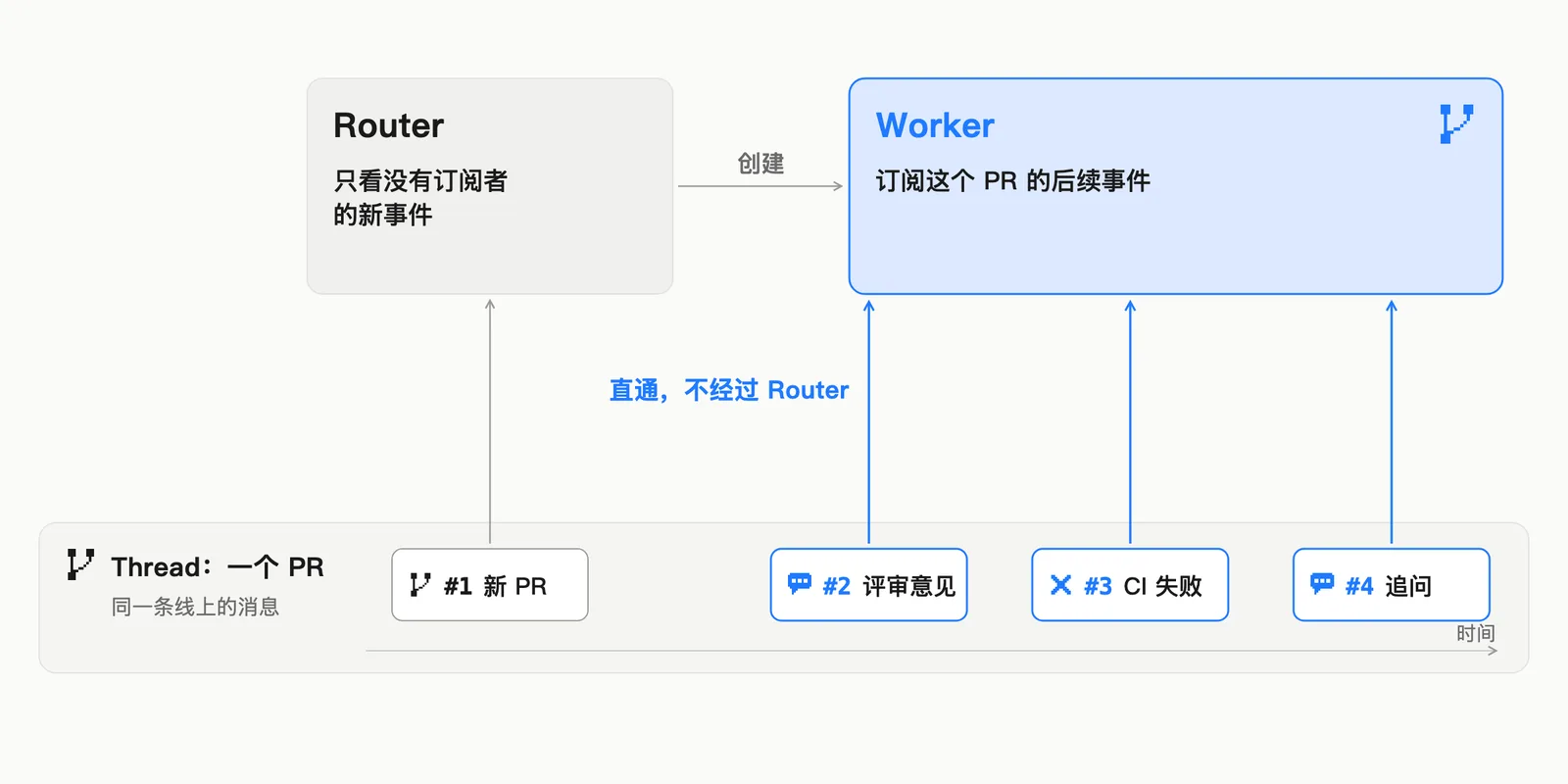
Subscription is many-to-many: one Worker can subscribe to several related Threads, and one Thread can also have several Workers subscribed to it. If some message falls outside the scope of the current task, the Worker can unsubscribe, or send it back to the Router to be assigned again.
The value of passthrough is very clear in the experiment. After passthrough is removed, the completion time is almost unchanged, but the decisions the Router has to make each round increase by about 30%, and the cache-read tokens rise from 23.20 million to 31.80 million. Passthrough does not make the task faster. It makes the Router spend less.
The open-source prototype writes this set of rules in finer detail. A person's later messages on the Thread go to the Worker that is doing the work, and no longer go through assessment. If the Worker thinks it does not belong to itself, it sends it back once, and only when no ticket claims it anymore does it enter assessment again. After a ticket ends, the subscription is still kept. The PR gets merged, someone comments again, and the same ticket is woken under the original authorization.
Event-Driven: From Waiting for a Person to Give Instructions, to Watching the Environment
The Super-agent's main input is no longer prompts a person types in one by one. It is semi-structured events produced in the environment: group-chat messages, email, calendar reminders, code-review comments, CI results. The article calls them Trigger.
Once there are many events, the first problem is which ones are worth handling. What it uses is still two levels, fast and slow. The fast level is program rules. It does deterministic admission by source, group, person, and bot whitelist, and each source can be set to "respond only to an explicit request," "treat as a candidate," or "ignore." Only the slow level is handed to the large model, which combines the context with policy written as prompts and judges whether to act. Large-model reasoning is treated as the flexible but expensive slow path. Whatever can be blocked by code is not shown to it. This slow level is at the same time an extension point in natural language. If the team wants to add a rule, writing a paragraph is enough.
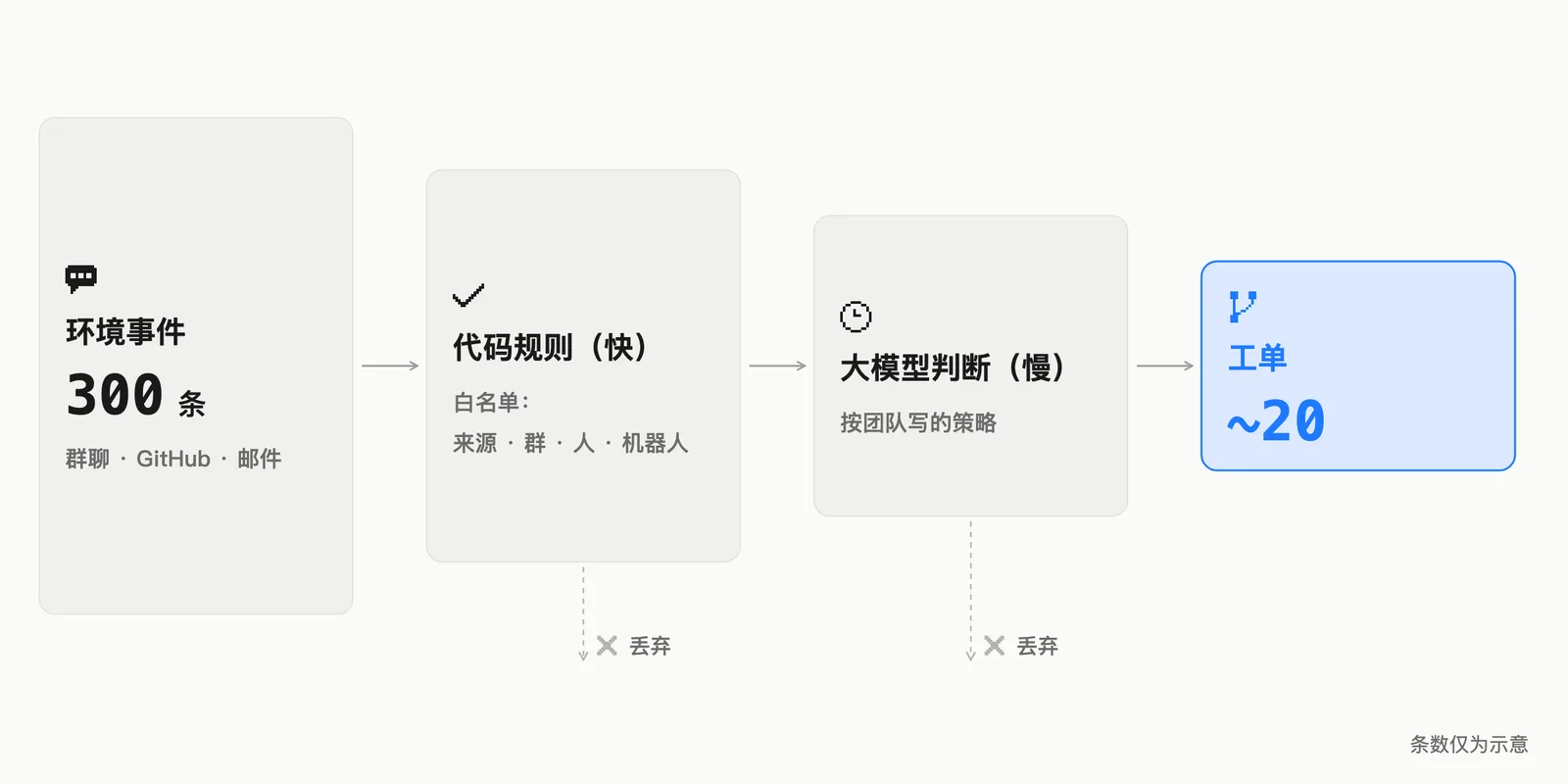
The prototype adds here a design I think is very important: authorization and context are kept separate. Who can assign work, under what rules the work was taken, and how large a scope it can reach, are recorded as one immutable "authorization," bound to the ticket. Messages that subscriptions deliver later, even when they come from bots and from CI, are only context, and carry no new permissions at all. Words in the group chat, and documents quoted in comments, can affect the judgment, but cannot change the permissions. Work that nobody asked for, and that was taken proactively by a rule, enters by default a mode of "only recording what it would have done," and the team lets it loose only after seeing that there is no problem.
Context: The Window Is a Cache
This section is the one in the whole piece I think is most worth reading over and over. The core sentence: wasting the context window is wasting the model's intelligence.
This sentence is worth remembering for everyone who builds Agents.
It manages the context window as a cache. What it borrows is the language of Inline and Spill from compiler optimization, in three steps:
- Start from the least information, and give only the ID and a summary of the current object.
- Inline gradually by locality: first attach the IDs of tightly related objects, then bring in what is adjacent in time and in space, for example the first 50 characters of a message, the few IM messages before and after it and the one it replies to, and the neighboring comments in the discussion a code comment sits in.
- Spill once past the limit: long content keeps only a short piece, a continue-reading entry is left at the cut, and when the model needs it, it calls a tool to go read.
On top of this is chain recall. A Trigger, a Thread, a Worker session: every object has a unique ID. When one object is injected, the IDs of related objects are brought along with it, and these IDs linked together are a reference graph. Each time the model recalls an object, the returned result likewise follows "inline plus spill," and also brings out the summary and the ID of the next hop. So it can walk hop by hop, and how far it walks is decided by itself. For example, from the Thread the current message is in, it jumps to some related Worker session, then jumps to another code-review discussion this Worker is associated with.
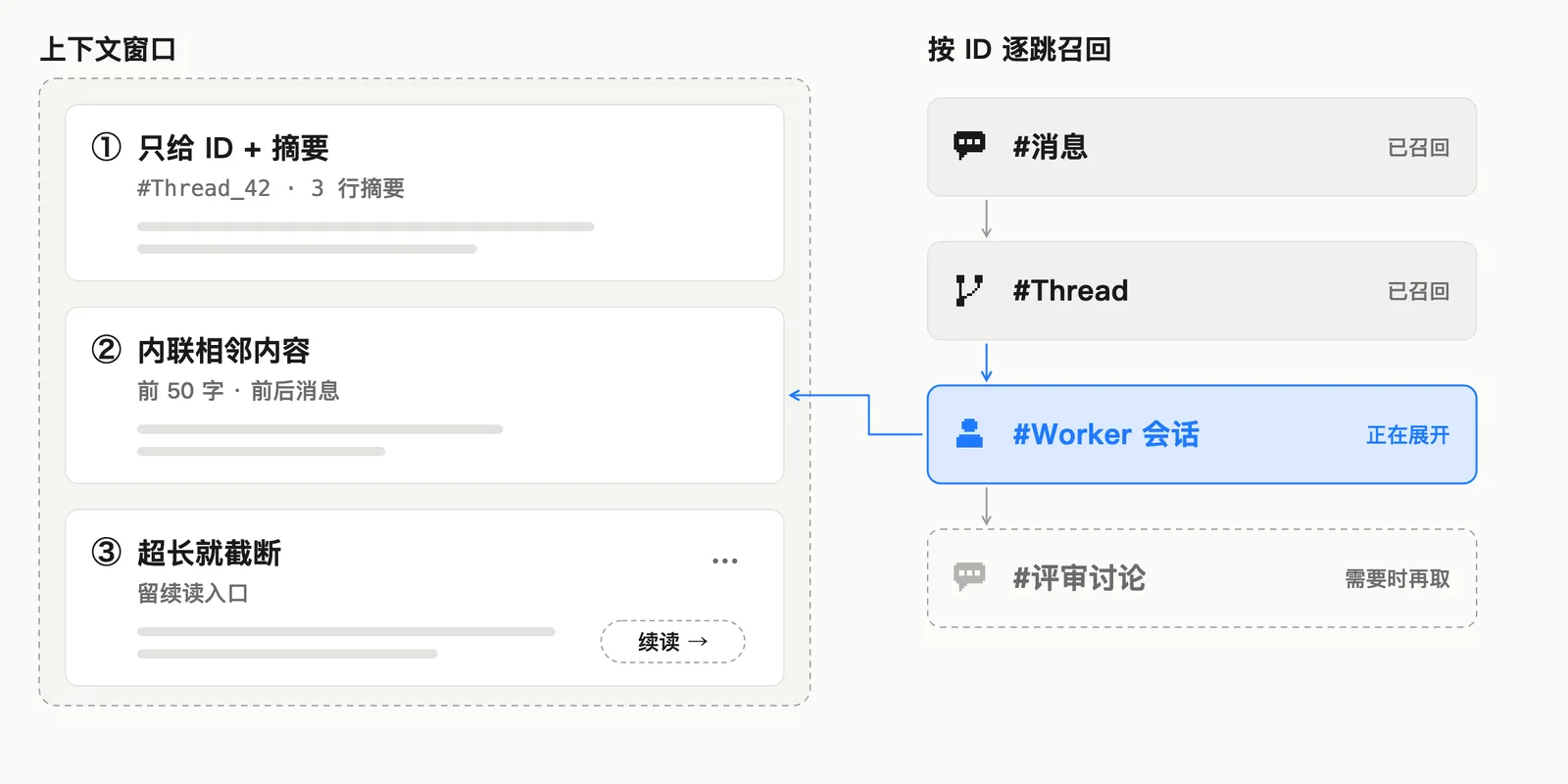
What this solves is the Router's memory loss after it has been running for a long time. A user brings up again, in another channel, a task from very early on, and it can find its way back along the IDs, instead of stuffing all the history into the window the whole time.
The prototype turns this into concrete numbers. When an event is evaluated, the body is at most 4000 characters. From the Thread it takes the first 5, and 5 each before and after the event. Each one is generally cut to 400 characters. The few right next to it are relaxed to 1200 characters. The remaining messages keep only a 50-character preview. To see the full text, expand it by ID.
Speculative Execution: Try It in the Background First, and Speak Only When There Is a Result
This too is a term borrowed from computer systems. On signals from the environment, it starts the work ahead of time in the background. If the result has value, deliver it; if it has no value, throw it away. Extra background compute is traded for less waiting and less intervention from the person.
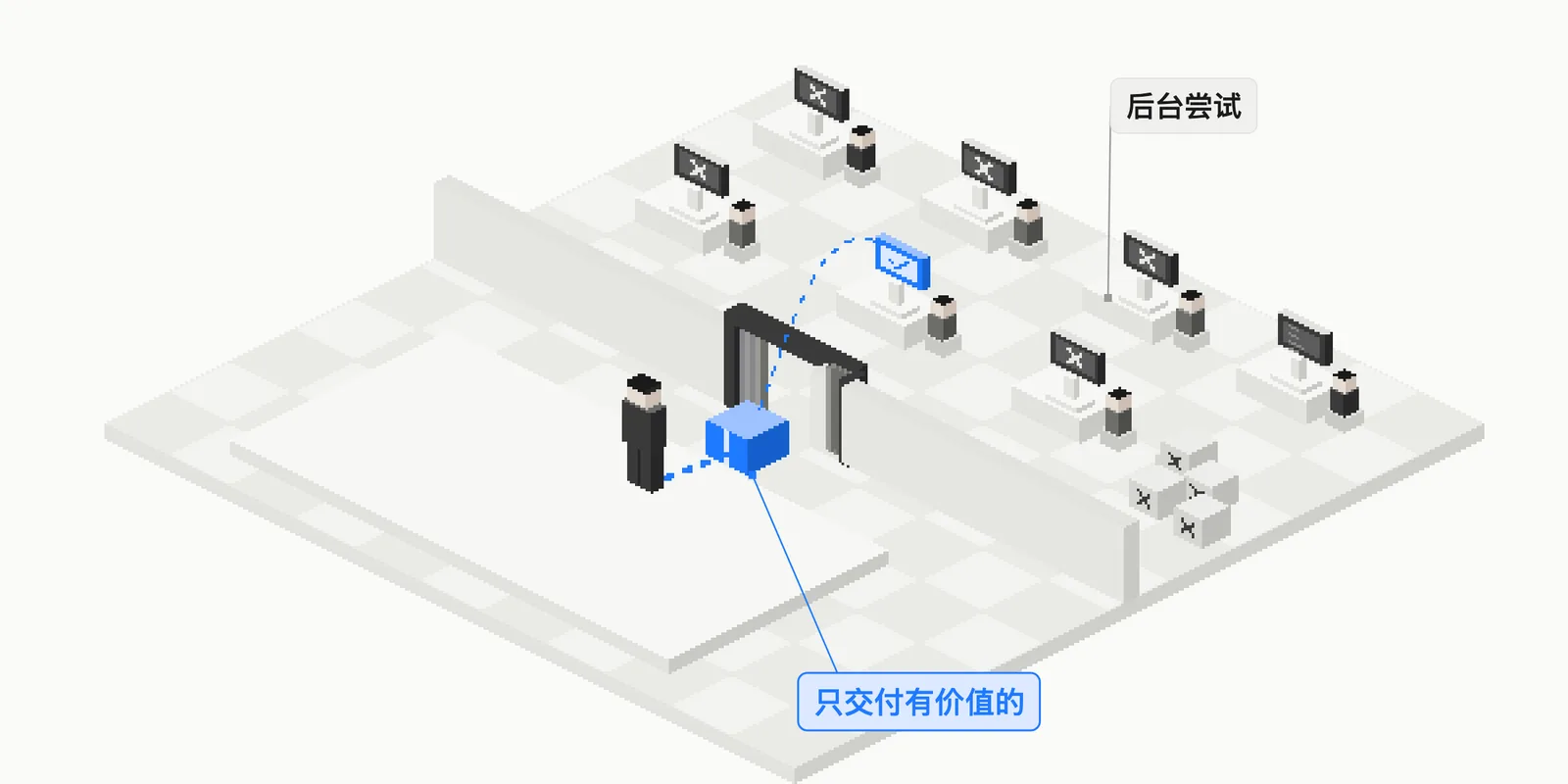
The article gives two examples. A personal scenario: a meeting invitation comes in, and it first checks for a calendar conflict, searches the other party's background, and drafts a reply. An R&D scenario: their internal user group is configured with a policy of "silently reproduce and fix." The Agent looks at the feedback in the group on its own, and only when it has confirmed that the problem exists, and has found a simple fix, does it deliver a PR. Otherwise it makes no sound the whole way through.
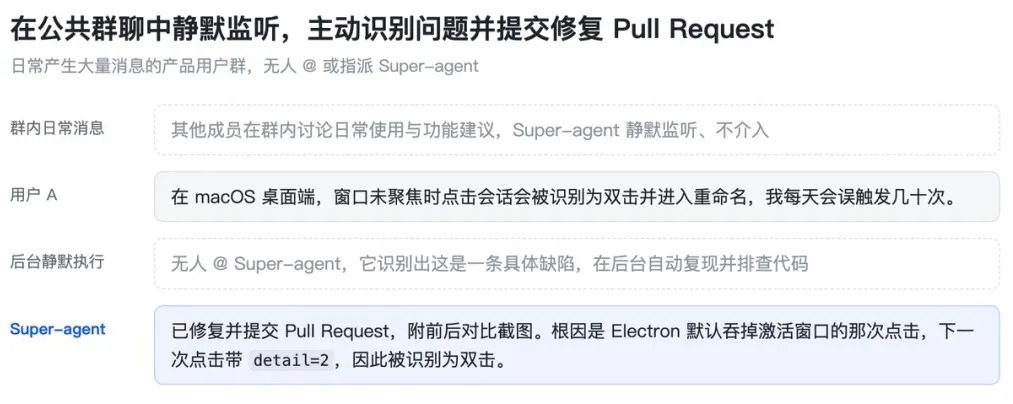
This corresponds exactly to the principle the prototype states at the outset: take as little of a person's attention as possible, and give as much value as possible. Every message, every notification, every question has to prove that it is worth occupying that bit of attention. Otherwise, delete it.
Put plainly, it is this: do the work first, then decide whether to disturb you.
Full Duplex: Dispatch It and Return
The classic Agent loop is synchronous. Call a tool, and keep waiting until it finishes running. Super-agent turns time-consuming commands and tool calls into asynchronous ones: right after the call, it returns "started," and the model can go on handling other input; when the tool finishes running, the result is posted back into the session as a new event; if it runs too long, the model can stop it on its own.
Interaction then changes from half duplex (I speak after you finish) into full duplex. A new message gets handled once the current step of reasoning ends, without waiting for the long task to finish running. The article specifically notes that DeepSeek Harness has already implemented this asynchronous mechanism. It just has not turned it on by default yet.
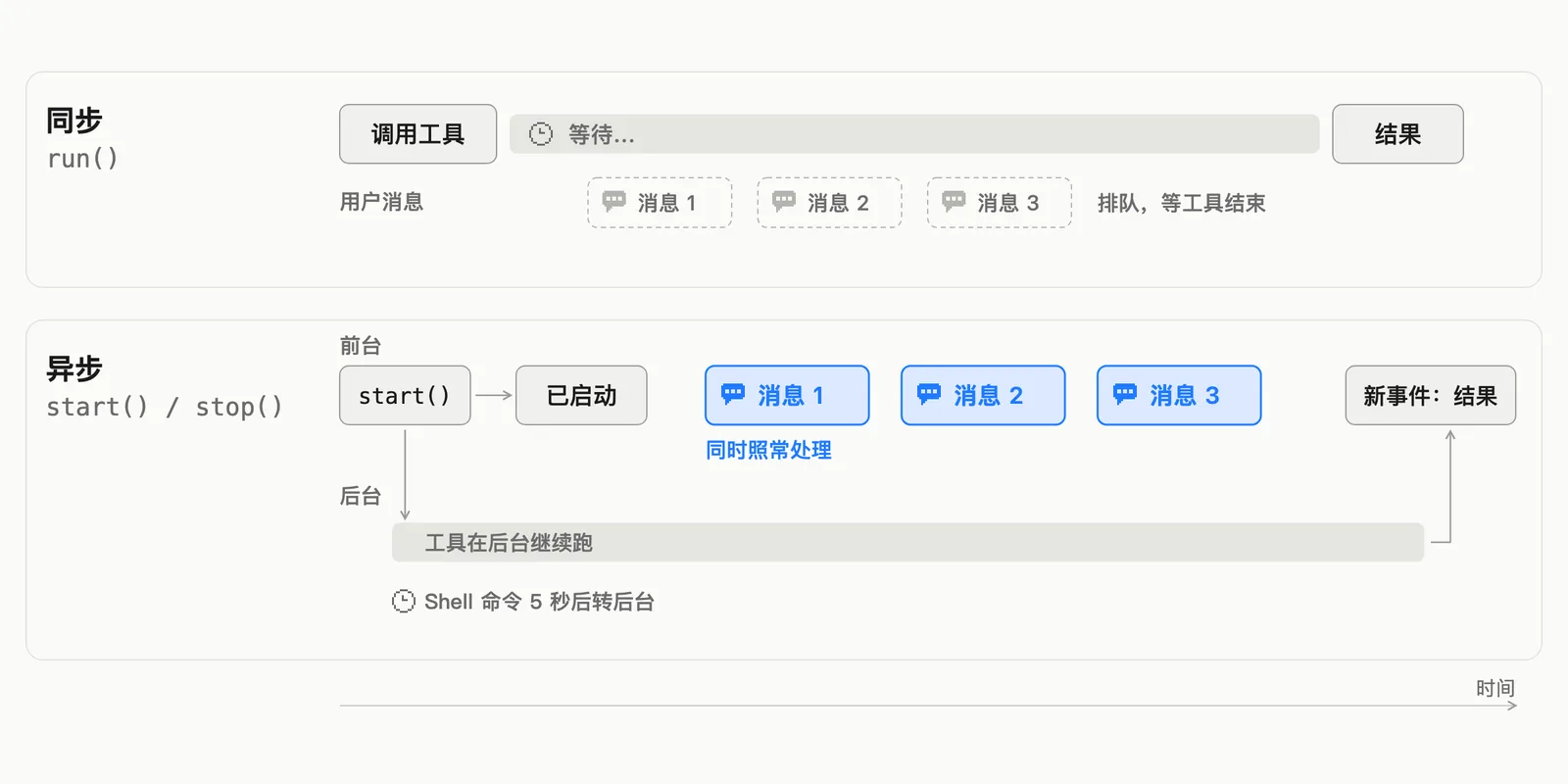
The parameters in the prototype are very concrete. A Worker's foreground command moves to the background automatically after 5 seconds, so that at the next step it can receive new messages. After a round ends, a background task runs for at most another 30 minutes. On the Router side, sleep and long waits are specifically blocked, because a report will deliver itself, and waiting only delays new events. Beyond the concurrency cap, one extra slot is reserved, specifically for the person's messages and status queries. However much new work comes in, it cannot crowd out a person's follow-up questions about work already underway.
Output is also split by channel. In IM it is low-disturbance, like a colleague. It speaks only when a decision or an acceptance is needed, asks only direct questions, and gives a short conclusion. They have verified one simple and effective hard rule: a single reply does not exceed 100 words. In GitHub, email, and documents, it is structured, high-density delivery, for example writing out in a PR the background of the problem, a description of the change, and the verification results. The two-layer architecture itself also helps: the lengthy reasoning and the tool logs are shut inside the Worker, and never reach an external channel at all.
This rule of 100 words is simple and crude, but very effective.
Separation of Storage and Compute: The Brain Goes to the Cloud, the Hands Stay in Place
A local Agent by default binds three things to the same machine: the compute that runs the Agent loop, the session state that needs to be persisted, and the execution environment (the code repository, the local toolchain). The moment the machine is off, all three are gone together.
The article splits them apart in two steps. Step one, separate compute and state: the Agent loop goes into stateless, elastically scalable containers in the cloud, and state such as the session is stored in a database. A container can be scaled out, restarted, or replaced at any time. Step two, separate compute and the execution environment: the heavy-state environment stays in place. The device side deploys only a lightweight daemon that does not save session state, responsible only for executing commands and returning results.
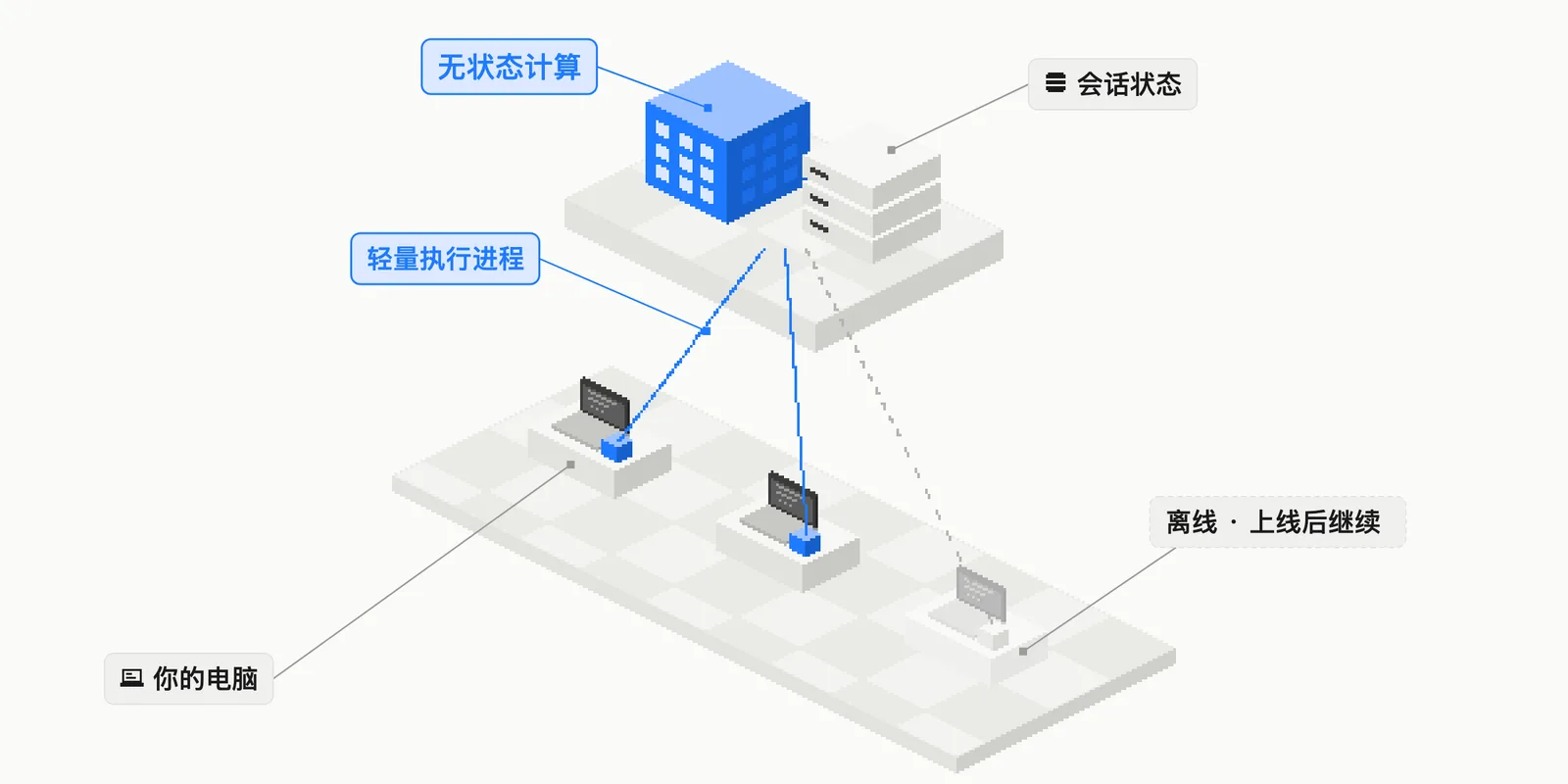
It explicitly rejects two common practices. One is starting a sandbox in the cloud, pulling the code, and rebuilding the environment, because a real environment has uncommitted changes, private credentials, intranet dependencies, and specific hardware, so the cost of syncing is high and things are easy to leave out. The other is having the user move the work to the cloud, where the migration cost is too high.
The article directly quotes Anthropic's "decouple the brain and the hands," and acknowledges that the thinking is the same. The difference is the setting. Anthropic is aimed at a hosted service, and what it discusses is sandboxes created on demand and resources inside the customer's own network. What DeepSeek has to connect first is the personal computers people use every day, which may be there at some times and not at others. They call this BYOM, bring your own machine. When a device comes back online, the cloud Agent automatically goes on and finishes the things that need to be done on that device.
Worth mentioning: this piece is not implemented in the open-source prototype. The prototype is one SQLite file on the local machine, running on the operator's own computer. What the prototype does is another kind of persistence: what has to be done after each decision is stored first, and only then done. After a restart, an interrupted task starts again with a recovery note attached, requiring the Worker to check the directory, the git history, and GitHub first, and only then decide whether to repeat any outward action.
Watchdog: Put Another Pair of Eyes Outside the System
The article's own words are: a distributed system that stays online continuously is hard to keep reliable over the long term by internal logic alone. It needs an independent control loop outside the main system.
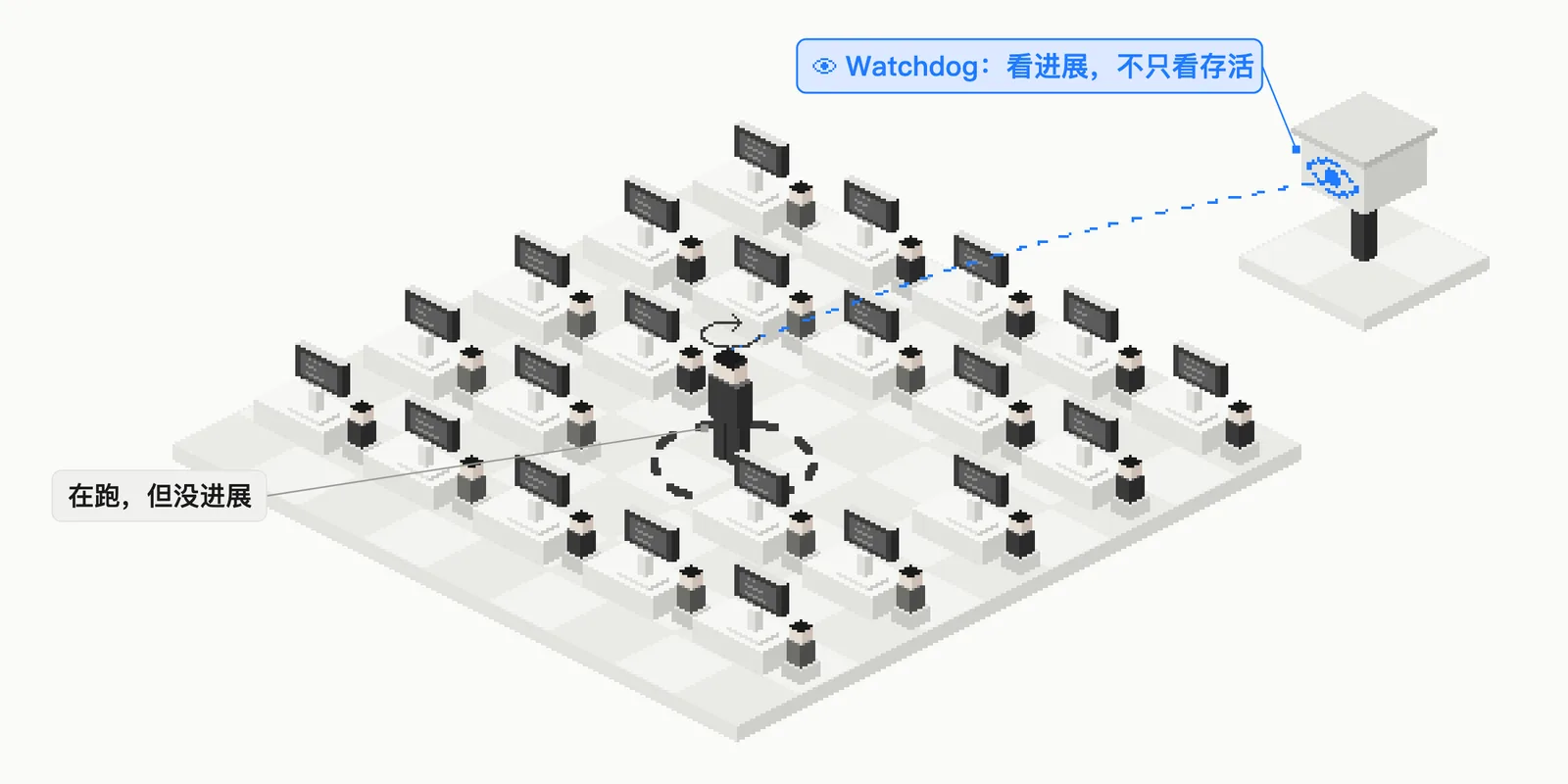
Why is a liveness probe not enough? Because many anomalies are not crashes. The process is still alive, but the model is spinning in place, or has already gone off course.
So outside the main system they place an independent Watchdog session, driven by timed messages. It handles two kinds of things. One kind is infrastructure, such as an interface reporting an error, or a failure to restore state. The other kind is left to the model to judge: whether each Worker has made real progress, and whether its direction has deviated from the overall goal. When it finds something wrong, it steps in and repairs it. When it meets an occasional fault from outside, it keeps checking again until recovery. It is itself an Agent with a full set of tools. A maintainer can ask it, in natural language, what caused a fault, and can also have it change the main system's behavior online, for example adding or deleting prompts, or adjusting trigger rules.
It is a bit like a good project manager on a team: they do not write the code themselves, but they are always watching whether the work is moving forward.
A Closer Look at the Experiment Data
The experiment uses a synthetic load. Four setups run at the same time, driven by the message stream of group chat and GitHub CI. Each run is about 300 messages, of which about 20 are real work requests, and the rest are small talk, follow-ups, cancellations, and CI messages. Writing code is simulated with a tool that "only consumes time." Each setup is run 5 times. Completion time is counted from when the request is sent to when the result message is sent.
| Setup | P50 | P95 | Cache-read tokens / run |
|---|---|---|---|
| Super-agent | 12.4 minutes | 15.7 minutes | 23.20 million |
| Super-agent, passthrough removed | 12.6 minutes | 15.5 minutes | 31.80 million |
| Single session + sub-Agent, neutral prompt | 20.4 minutes | 29.5 minutes | 6.10 million |
| Single session + sub-Agent, prompt prioritizes delegation | 13.8 minutes | 29.0 minutes | 10.80 million |
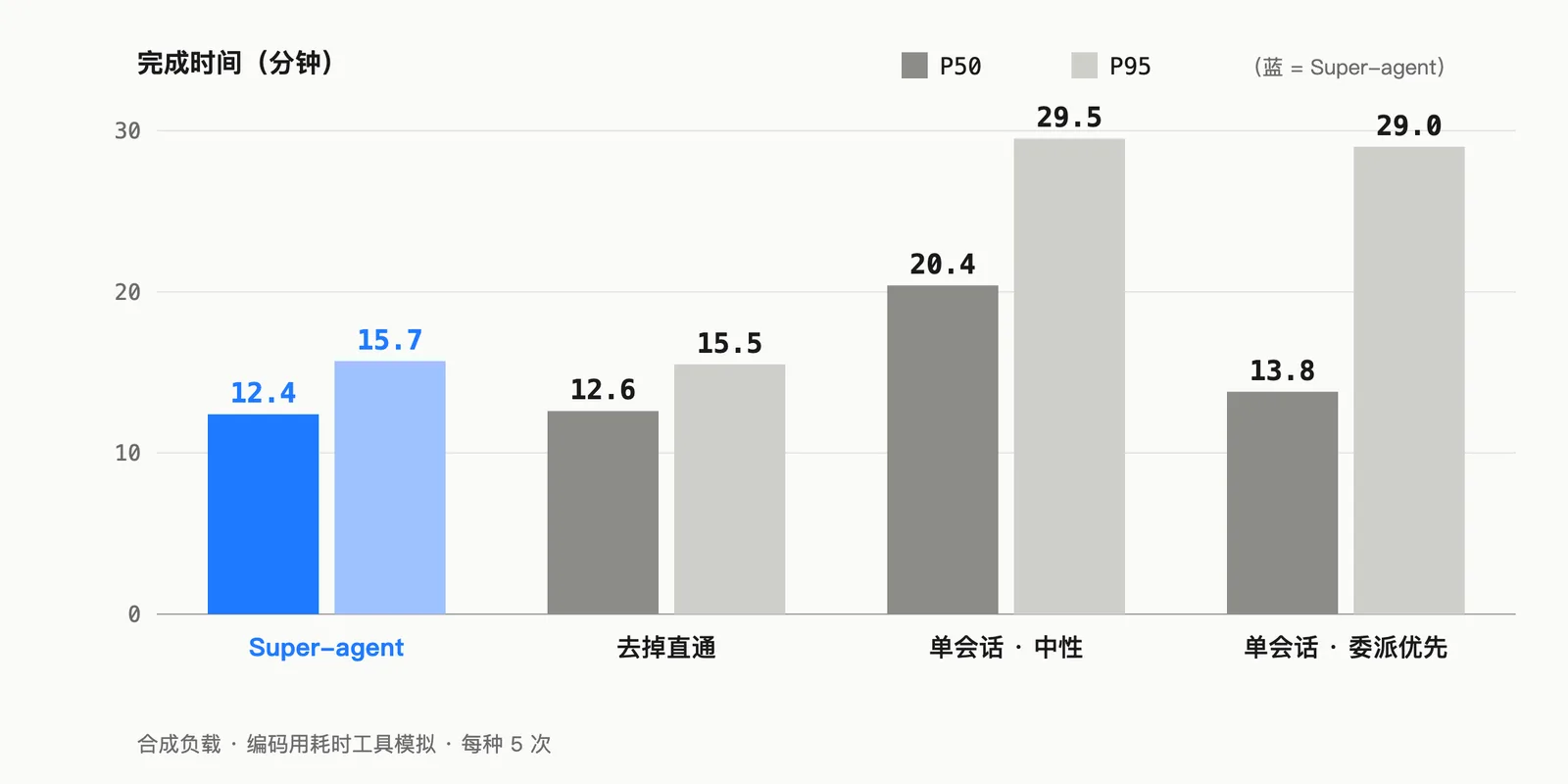
The most interesting part is not that Super-agent is fast, but why the two baselines are slow. Under the neutral prompt, across 5 runs the model did not call a sub-Agent even once. All the work was crammed into the main session, and kept getting interrupted by new messages. Changed to prompting it to prioritize delegation, in the 5 runs it delegated 4 times. The remaining 1 time, the model thought the work was "very small" and did it itself, and so dragged out a long tail. The P95 was still 29 minutes.
The model will not split work up on its own. This may be the point in this set of experiments most worth remembering.
The conclusion is: a single-session setup can rely only on the prompt and on the model's judgment in the moment to decide whether to hand work out, while the two-layer architecture solves this problem at the level of the system. The cost is using more tokens in exchange for a shorter, more stable completion time. Cache reads are about 3.8 times the neutral baseline.
Reading this set of data, keep its boundary in mind. The load is synthetic, the work is simulated, and what is measured is scheduling and coordination, not whether the code is written well, and not the total cost or the person's supervision time. The author himself also says the results are for reference only.
The Questions DeepSeek Itself Left
At the end, the article lists four open questions. I think they are more valuable than the conclusions.
How does the architecture extend. The combination of "one resident Router, subscription plus passthrough, and no direct communication between Workers" can already cover most everyday tasks. What to do when the scale is larger and the tasks are coupled more tightly, when the Router should be sharded and how fine the shards should be, and when peer Workers should communicate directly, is not settled yet. They also mention that a model could be trained specifically for the Router's work. Once it has been running for more than a few months, long-horizon memory becomes the main bottleneck.
Once there is no session, how does a person collaborate with an Agent. The underlying session no longer corresponds to one dialog box on the interface. How should a task be presented to the person? The article holds that the chat window's becoming the center of interaction is partly path dependence, and that more of the interaction may go back into domain interfaces, for example working directly on a GitHub Issue and a PR. To let a person step in, take over, or collaborate in real time at any moment while execution is in the background, the final design may be highly customized.
Context boundaries. How a Super-agent is deployed is, in essence, a decision about which context is shared and which is isolated. A personal Agent and a team Agent obviously should not see the same things. For isolated instances to collaborate with each other is the problem of communication between Agent and Agent.
Security and privacy. Being event-driven makes the surface on which an Agent touches untrusted input much larger. The design of a cloud loop plus a device-side daemon carries an implicit assumption that the cloud and the device side trust each other. Once the server is broken into, or is hit by prompt injection, every device that is connected may be controlled. Even if the cloud is fine, as long as credentials on the device side can enter the model's context, ordinary work can also leak the credentials out. What they say is: an Agent needs a way to use credentials and yet never see the credentials.
A Few Reflections After Reading
First, the value of this article is not in some new algorithm. It is in having changed the question. What people used to compare was whether a single Agent could do one thing well. What it asks is how one person makes many things move forward at the same time. The answer lands on system design, not on the model.
Second, the whole piece uses old methods: the fast path and the slow path, the cache, separation of storage and compute, speculative execution, the Watchdog. These things have already been proven for decades in operating systems, databases, and distributed systems. Agent systems are walking again the road computer systems have walked, and people who understand systems will have a real advantage in this wave.
Third, its restraint about "disturbing" may matter more than the architecture itself. The cap of 100 words, speaking only when a person is needed, and proactive work that is at first only recorded and not executed, are all an admission of one thing: an Agent that can do the work of a whole team can also waste a whole team's attention.
Fourth, it is honest. The prototype is not production-grade. Some of the designs in the article did not make it into the open-source code. The experiment is simulated. The open questions are listed at greater length than the conclusions. This way of writing is itself worth learning.
Reference: the DeepSeek Harness team, "Exploring Super-agent Design: Towards a More Autonomous Agent System"; GitHub deepseek-ai/dsh-superagent-prototype and its docs directory.